
What do positioning and sex have in common? Every generation thinks they invented it.



There’s a lot of competition out there to “fix” positioning. To deliver the new framework, process, or tool that blows open a whole new way of thinking about it. Positioning is straightforward. It’s the process of teaching the market what you are, who you're for, who you compete with, why you're different, and why you're great. You can't change it any more than you can change the molecular structure of water.
The great sci-fi writer Robert Heinlein once wrote, “Each generation thinks it invented sex; each generation is totally mistaken.” I think you can say the same thing about positioning.
Positioning as an idea has been bouncing around business and marketing culture since the late 1960s. If you follow the literature (and the topic on LinkedIn), you’ll find a lot of people claiming to have changed positioning somehow.
I’m taking the opposite approach.
I humbly submit that while I’m here to add whatever I can to the discipline of positioning, I have zero interest in redefining what it is.
The best positioning framework is the one you will actually use, that helps you think clearly, build consensus, and take deliberate action.
As long as it covers these five topics:
If you want a nice, clean definition in a sentence, then I’ll give you mine.
Positioning is the act of teaching a market what a product is, who it’s for, what makes it different, and why it’s great. If you want to get clinical about it, you can look at it like this:
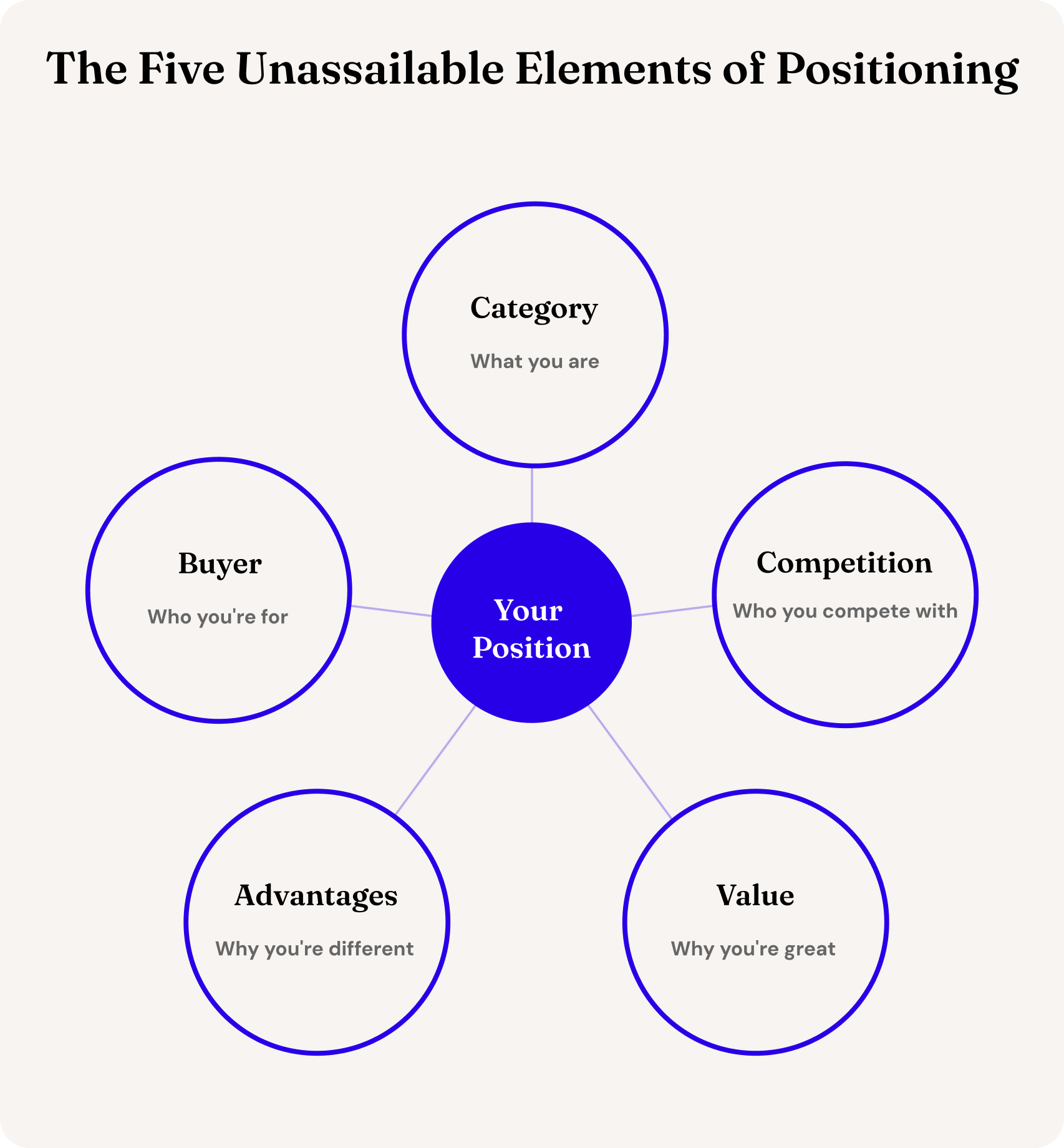
If you’re doing a good job with positioning, you have clear, honest, plain English answers to these questions.
You can easily describe the category where you compete, the buyer you win, the reasons your buyer chooses you (I prefer to frame these as advantages, not differentiators. More on that later.), and the unique value you offer.
Maybe you want to add to this list. Maybe you want to play with the order, or say something a different way. I say, do what works.
The single best thing I did for my career was to stop and ask where “best practices” actually came from. It became an incurable habit.
I love learning about the provenance of ideas. And I think it’s incredibly powerful. Knowing the provenance of your ideas can keep you from getting stuck in an intellectual rut. It can help you see the precepts and assumptions surrounding your work for what they really are: mostly opinions.
Even about positioning.
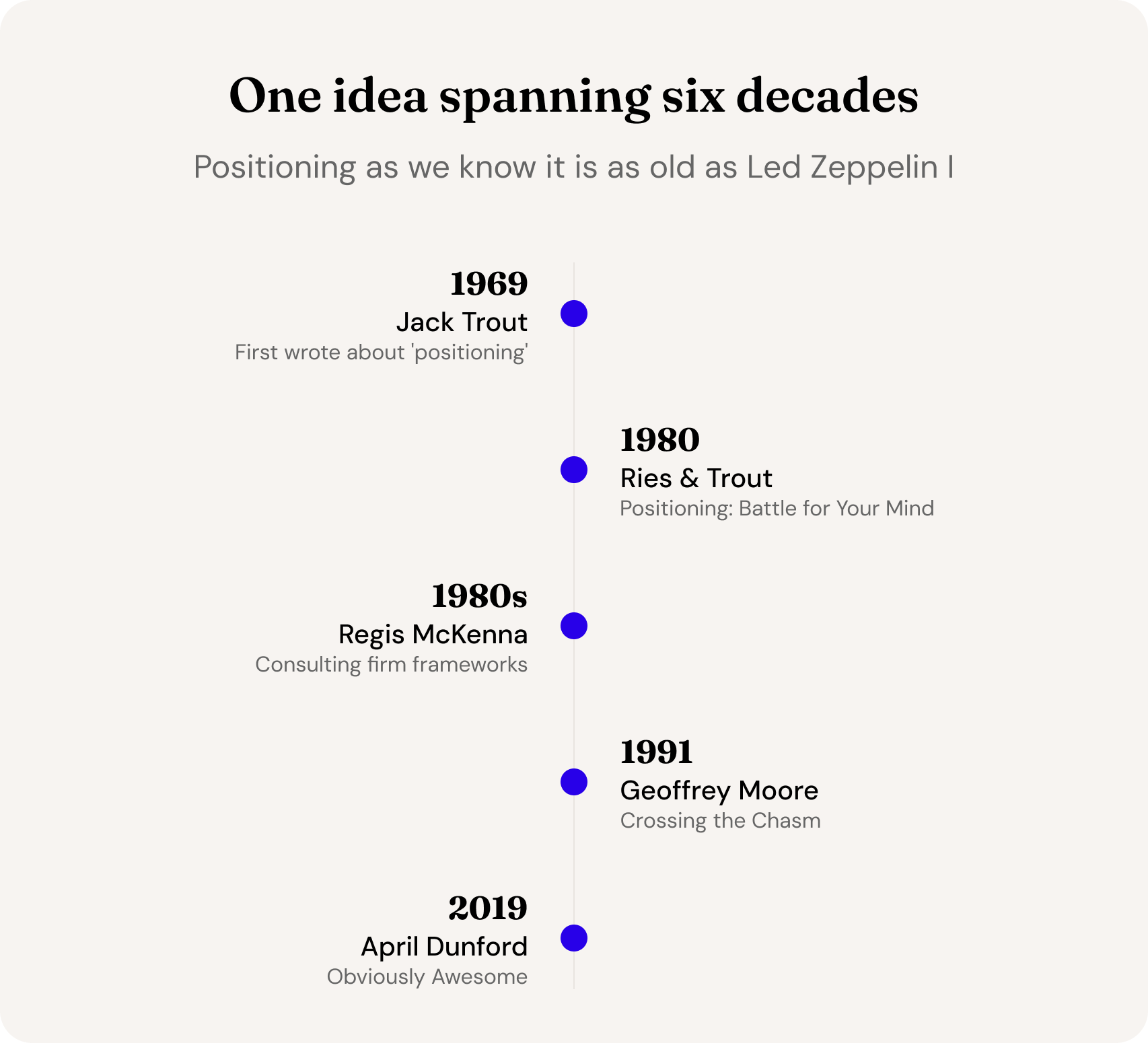
The term "positioning," as I’m using it here, comes from the book Positioning: The Battle for Your Mind by Al Ries and Jack Trout, which was published in 1980. (You probably know that.)
But Jack Trout first wrote about “occupying a unique position in the mind of the buyer” in 1969. So, the idea of positioning as we know it today is decades old. It’s also made up. There’s no research mentioned in that article or the book. (You probably know that, too.)
Does this mean positioning is bullshit? I don’t think so. Yes, I think the idea that human beings have tiny slots in their brains for the things they buy is probably an overstatement.
But teaching an entire market what a product is, who it’s for, what makes it different, and why it’s great is an inarguable, fundamental act of marketing. I don’t need to run a 20-year longitudinal study to know that people are much less likely to buy products they don’t understand, think are for other people, or can’t tell apart.
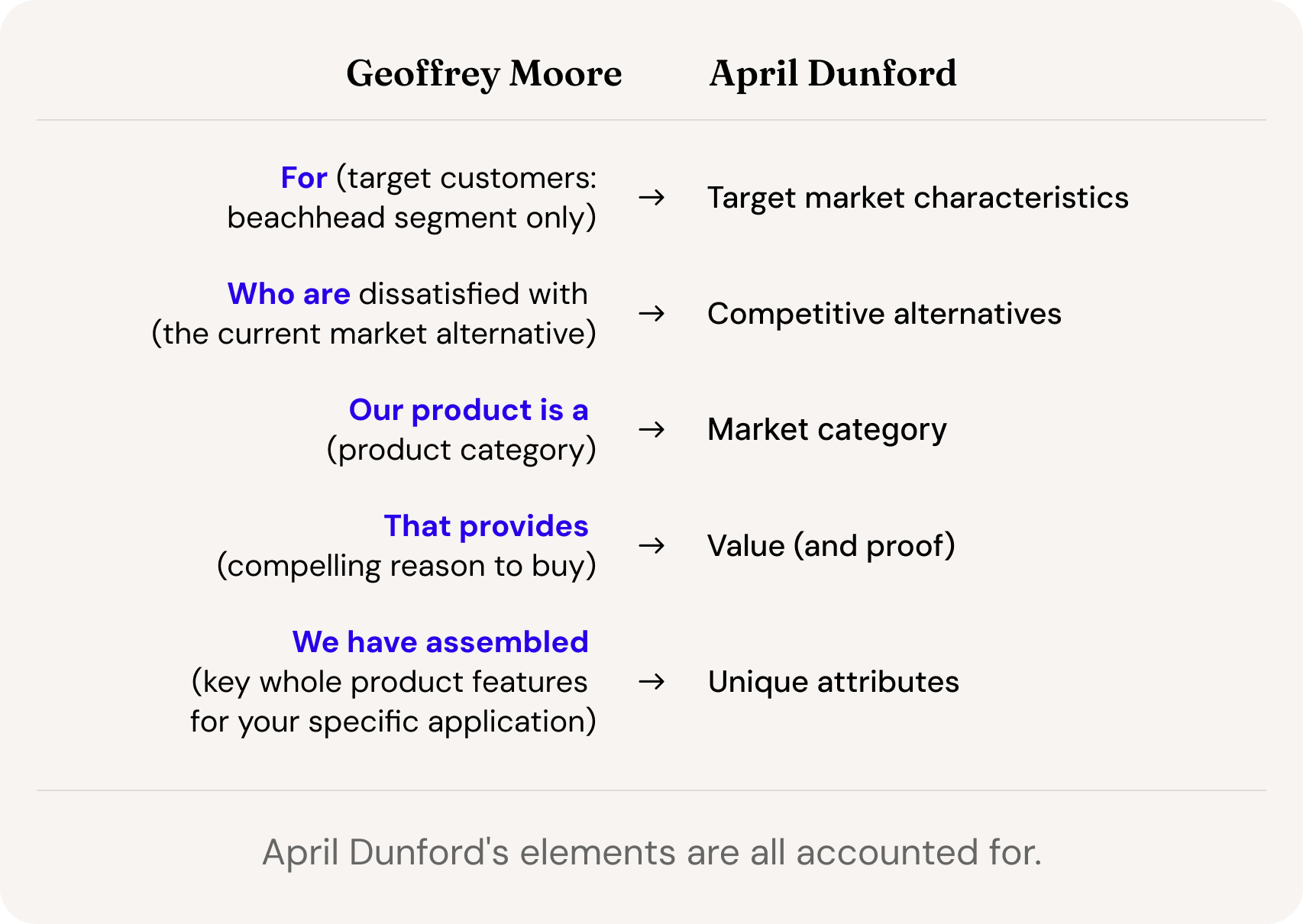
I’m going to jump ahead to what I think is actually the book that gave us positioning as we know it in the B2B tech universe, Crossing the Chasm, by Geoffrey Moore. In the book, this is the exact way Moore breaks down this positioning statement formula.
If I bring back up my five unassailable elements of positioning, they’re all covered.
I’ve read Crossing the Chasm many times. I still think it’s great. I think Geoffrey Moore’s positioning statement formula is sound. But here’s the funny thing about the provenance of ideas. I’m not so sure the positioning statement originated with Geoffrey Moore.
In the 1970s and 80s, Moore worked for a consulting firm named Regis McKenna, which was a sort of mini-McKinsey for the technology industry. You can dig into it yourself, and you’ll see that many of the ideas in Crossing the Chasm came from Geoffrey Moore’s time at Regis McKenna.
Maybe he came up with the approach all by himself while at Regis McKenna (and in fairness, Moore mentions the firm in the acknowledgements at the end of his book)...but that’s not really how things go.
I’m willing to bet the positioning statement formula was bouncing around Regis McKenna for a good while before Moore published it. I’m sure he shared it because he knew it worked.
Call me old-fashioned. I think it still does. (Even though I don’t use the run-on sentence format, which I find clunky.)
Let’s jump ahead to the other major book about B2B positioning, April Dunford’s Obviously Awesome. I think it’s a great book, and it's a huge inspiration for In The Kitchen. I could write a long piece about what I appreciate about that book, and April is one of the giants upon whose shoulders I stand.
But I don’t think April Dunford changed Geoffrey Moore’s elements of positioning, which he probably picked up from his colleagues at Regis McKenna, who were probably influenced by Jack Trout.
Here’s a list of what April Dunford calls the “Five (Plus One) Components of Effective Positioning”. (I’m skipping the “plus one,” “relevant trends”....I don’t think it really holds up, and she calls it optional.)
….if I bring back up the Moore framework…. April Dunford’s are all accounted for.
Which is why my second-least favorite part of Obviously Awesome is the opening where April Dunford says positioning statements are dumb and tells people not to use them. (I’ll get to my least-favorite in an upcoming Deep Read.)
I think Dunford gave us a useful framework for working on positioning.
I don’t think she changed it, though.
The world we live in rewards the new. The new AI tool, the new marketing buzzword, the latest tactic. It’s an addiction. That’s a shame, because a lot of the best ideas are old. My feeling about positioning is that we should spend less time trying to redefine it and more time trying to be great at it.
If you decide you like what I’m writing here and want to hang out on this page, that’s what you’re going to get. Reflections on a craft. Not reinvention of the wheel.
Thanks for being here.
Long-form writing may be a dying art. But if you love a good stemwinder, these are genuine, human-being-made articles that explore topics that don’t fit in a 600-word box.
The great sci-fi writer Robert Heinlein once wrote, “Each generation thinks it invented sex; each generation is totally mistaken.” I think you can say the same thing about positioning.
Positioning as an idea has been bouncing around business and marketing culture since the late 1960s. If you follow the literature (and the topic on LinkedIn), you’ll find a lot of people claiming to have changed positioning somehow.
I’m taking the opposite approach.
I humbly submit that while I’m here to add whatever I can to the discipline of positioning, I have zero interest in redefining what it is.