
Better products don’t win. Better competitors do.



Tech industry mythology leads us to believe that if we just build a better product, we win. But that’s not how the world, people, or markets work. Product capabilities are just one of four dimensions that lead companies to win or lose in the market. The other three are credibility, convenience, and cost. Taken together, they’re a unified theory of competitive advantage, and probably the single most important thing I can teach you about.
I’ve worked with a lot of people in B2B technology. From 22-year-old SDRs to Magnificent Seven product managers to elders who created the internet as we know it.
All of them, to a person, fall into a thought trap that is so pervasive, so ubiquitous, that it’s invisible. Like the air we breathe and the water we drink, this myth is everywhere. Inside us. Flowing through us.
I’m talking about the belief that success or failure in the market results from a single factor: what our products do or don’t do. You can sum it up in just three words. “Better products win.”
I call this The Functionality Myth. And we all believe it because it’s the founding story of modern technology.
We don’t question this story because it seems obvious, and there are countless examples of better mousetraps that became world-changing technologies (or at least made their creators filthy rich). But when you put this narrative in a modern context, it’s more complicated than Emerson made it out to be.
Winning in today’s technology industry isn’t just about launching innovations that catch on. It’s about taking a leadership position in a market and defending it.
If you look at the products at the top of a contested category, you will rarely find the objectively best one in first place.
Is Salesforce the best CRM? Is Microsoft the best productivity suite? Is SAP the best ERP? Is McDonald’s the best burger joint? Is Facebook the best social media site? Is the iPhone the best smartphone?
The answer to these questions is objectively, quantifiably, no.
Salesforce, Microsoft, and SAP are famously complicated and frustrating to use. McDonald’s meat is dried out and skimpy, Facebook is a headache-inducing abomination, and Samsung consistently beats the iPhone on specs.
And yet, these are some of the best-positioned brands and products in the world. We should be so lucky to have a tiny sliver of their success.
You could argue that I just listed off a bunch of mature products in mature categories, and that in emerging categories, where a lot of startups play, the rules are different.
Yes, the competitive dynamics in emerging categories are different. (I’ll address that in a Deep Read to come soon.) But the brutal reality is that in the AI era, categories are being born and maturing faster than ever. Feature-based differentiation is decaying faster than ever.
See the fever-pitch gamesmanship among AI frontier model companies for a great example of this. The battle to ship the fastest, smartest, most capable models and AI platform features shifts in near real time. Today, Company X is has the best AI. Tomorrow, it’s Company Y.
The Functionality Myth is cracking apart before our very eyes, whether we like it or not.
Every day, it gets harder to win and keep winning based on functional advantages. The sooner you wake up to this, the better off you’ll be. If you are going to take and hold a leadership position in your market, simply being functionally superior to the alternatives won’t cut it.
Every word of every article and essay you will find on Deep Reads extends from one mission. I am here to help B2B companies fully understand why they win and build competitive advantages that compound over time. The first step in the process is to understand that “being better” is just the ticket to the party.
So if functional superiority isn't enough to win, what is?
I think there are two levels to positioning. Level One differentiates products solely on functionality. Level Two, which I'm advocating for, seeks out differentiation based on an expansive view of the product and go-to-market.
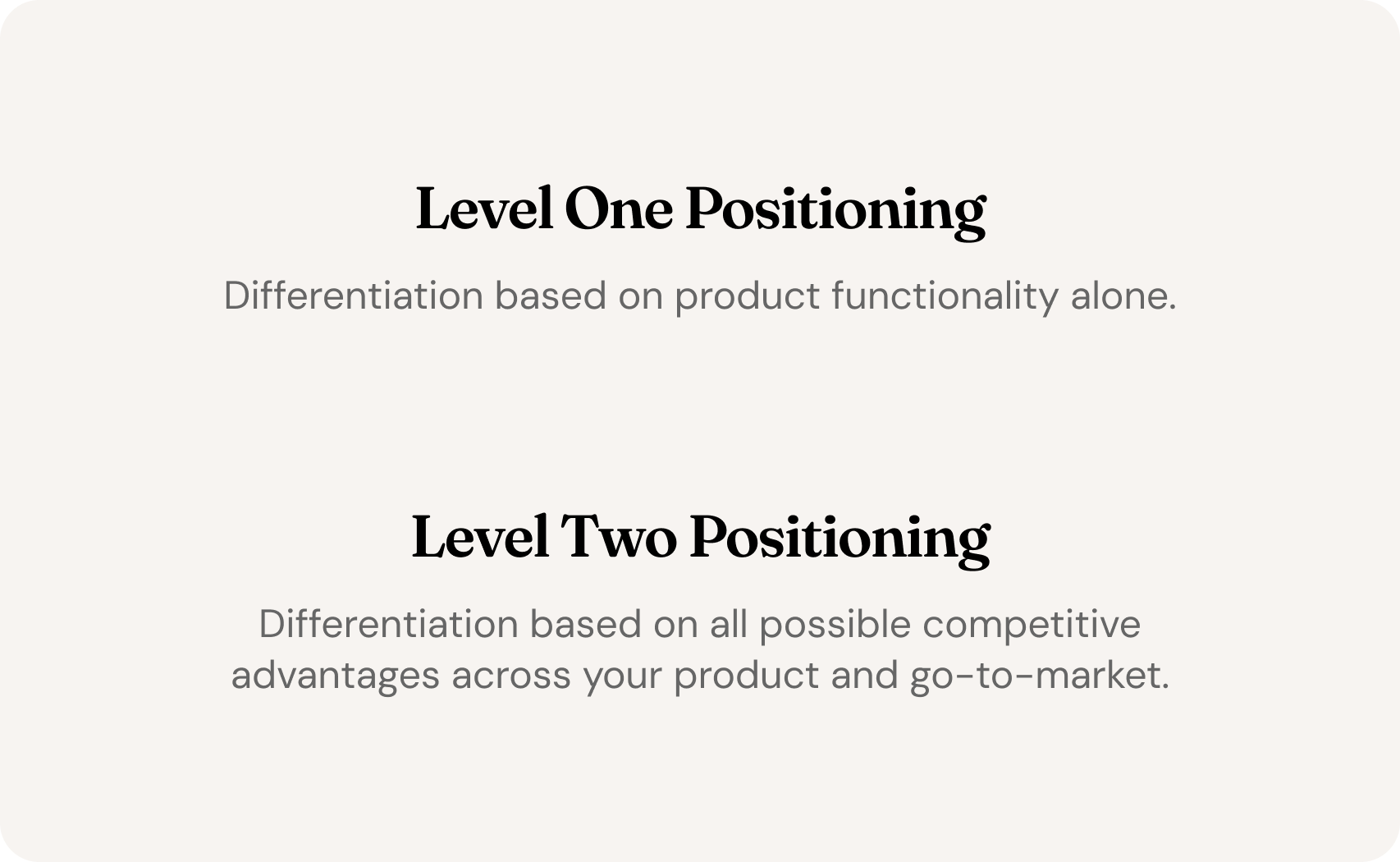
Level One positioning can work for companies hitting their first wave of growth in an emerging category. But in a contested category with emerging leaders and/or strong incumbents, it has fatal flaws.
Level Two positioning happens when you look beyond product functionality, consider all possible advantages or disadvantages, and create a unified theory for why you win.
This is much harder work than Level One. It requires more humility, a stronger stomach, and a deeper willingness to see the unvarnished truth through your buyer's eyes. But if you can do it, it will transform how you think about winning. And make you much, much better at it.
The first step is to recognize that functional capability is just one of the dimensions that build market power and category leadership. There are four in total:
Capability, credibility, convenience, cost. The Four Cs, if you want to go there. Four dimensions. Four walls in your house. Four sides to your fortress. Pick your metaphor.
The short version of where these four words came from is….from my brain. The longer version is that there is substantial data and theory behind my thinking here. I’m going to spare you for now. Because this is just an essay, and I’m a practitioner, not an academic. (If I write a book version of this, you’ll see it there.)
But I think each of the Four Cs is self-evident if you take a minute to think about them.
Yes, of course, technology buyers care about what the technology they buy does. If you don’t have compelling functionality, you’re nowhere.
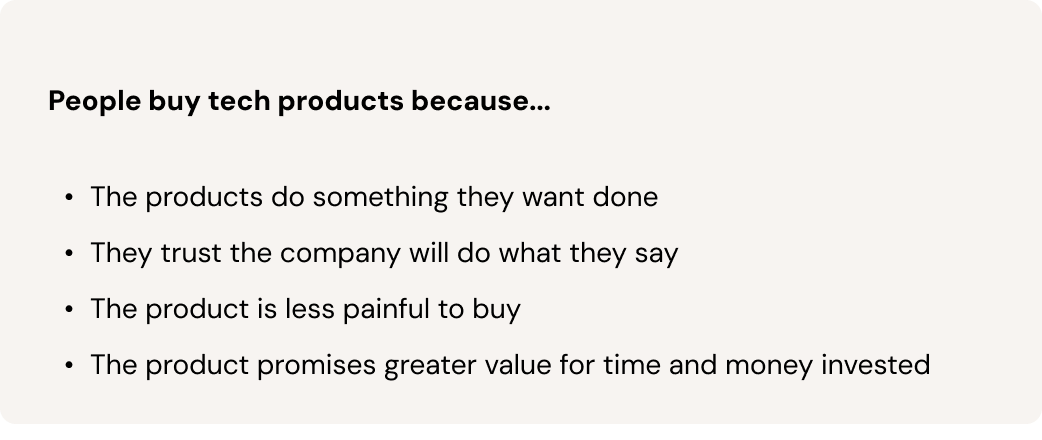
But buyers are much less likely to buy a product if they don’t trust the company selling it, if the product is inconvenient to buy, or if the cost feels too high relative to the value promised.
Capability, credibility, convenience, cost.
If you look at category leaders, you’ll see that they stack up advantages along multiple dimensions. Often all four of them.
(AI disclosure: I used Claude, ChatGPT, and Gemini for research and fact-checking to develop this next section.)
If any category should be won by the functionally best product, it should be cloud computing. Engineers, developers, and infrastructure teams are some of the most rational people on the planet, right? Who is better prepared to evaluate a tech product than them?
But a closer look at AWS’ journey to the top shows that they won the category for other reasons than functional superiority.
In the late 2000s, AWS had three competing alternatives that were objectively better at specific things AWS’ buyers cared about.
AWS was losing on several of the most important aspects of cloud computing. They had real advantages that caused serious pain points for buyers. But instead of launching a tit-for-tat feature war, they leveraged advantages across all four Cs.
AWS built one of the biggest, most profitable businesses in history. What they accomplished was extraordinary. But if you look across other categories, you’ll see similar Four Cs stories that played out, or are happening in real time.
Salesforce didn’t win on CRM features. It won with an advantageous subscription pricing model (a cost-to-value advantage), a cult brand (a credibility advantage), AppExchange (a convenience advantage), and a massive ecosystem (adding to both credibility and convenience).
The trick, which you’ll see in case study after case study, is to build advantages and stack them on top of each other. And if you follow success stories over time, you’ll see that market leaders often vaulted into a leadership position based on capabilities, and then cemented that position with the other three Cs.
…and if you look at emerging category leadership case studies, you’ll see how high-growth startups that seem invincible can stall out. Lovable is a strong vibecoding app with great branding and marketing. But Lovable’s product capabilities have major overlap with their competitors, and AI app builders are launching at breakneck speed.
Whether Lovable can keep its lead will depend on whether it can build the kind of compounding advantages (ecosystem lock-in, switching costs, deep integrations) that turned AWS from a first mover into a fortress.
If you come away from this piece believing that I don't think product capabilities matter, you're wrong. That's not what I'm saying at all.
What I'm saying is that your product capabilities are essential; they are the ticket to the party, they are the price of entry into your market. But that if you obsess over them and neglect the other three dimensions, you're setting yourself up for failure.
Product capabilities are indeed the most important dimension, but unfortunately, the fastest to erode. They are depreciating assets. Credibility compounds. Convenience compounds. Switching costs only go up.
But features? Your competitor can ship those next quarter. Or next week. Or tomorrow.
If capabilities are the only reason you win, you don't have a positioning strategy. You have a feature list with an expiration date.
If you want to be the leader, dig deeper.
Long-form writing may be a dying art. But if you love a good stemwinder, these are genuine, human-being-made articles that explore topics that don’t fit in a 600-word box.
I’ve worked with a lot of people in B2B technology. From 22-year-old SDRs to Magnificent Seven product managers to elders who created the internet as we know it.
All of them, to a person, fall into a thought trap that is so pervasive, so ubiquitous, that it’s invisible. Like the air we breathe and the water we drink, this myth is everywhere. Inside us. Flowing through us.
I’m talking about the belief that success or failure in the market results from a single factor: what our products do or don’t do. You can sum it up in just three words. “Better products win.”
I call this The Functionality Myth. And we all believe it because it’s the founding story of modern technology.